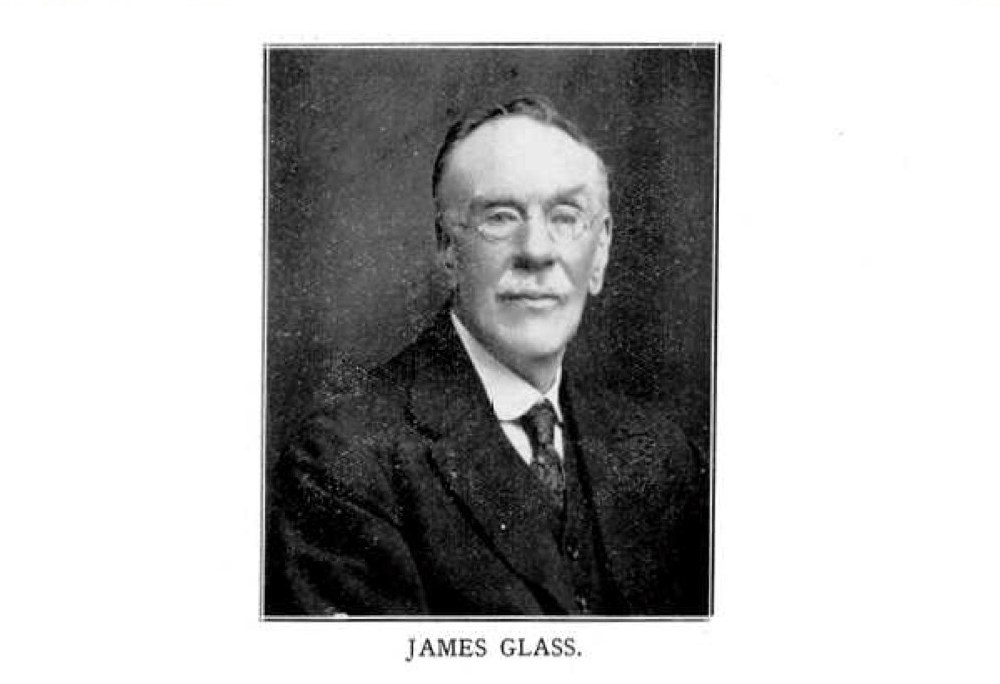
in this 1870s – 1880s period, while william fee mckinney in country antrim engaged in his antiquarian and photographic practices and enthusiasms – collecting farming, church and other records and artefacts (he had a deep interest in the history of presbyterianism in ireland) and in his participation as member of the belfast natural history and philosophical society and as member of the linen hall library – james glass (born 1847, died 1931) was establishing his skills and business as a professional photographer in the city of derry and also engaging within the broader presbyterian community in the city, becoming a respected member of his local presbyterian church – a superintendent of the sabbath school and senior elder at carlisle road presbyterian church, built in 1879 – to the extent of still being noted within his church community up to some twenty years after his death through a portrait and stained glass window gifted to the church by his wife and daughter and a bequest to the church in 1957 known as the ‘james glass bequest’.

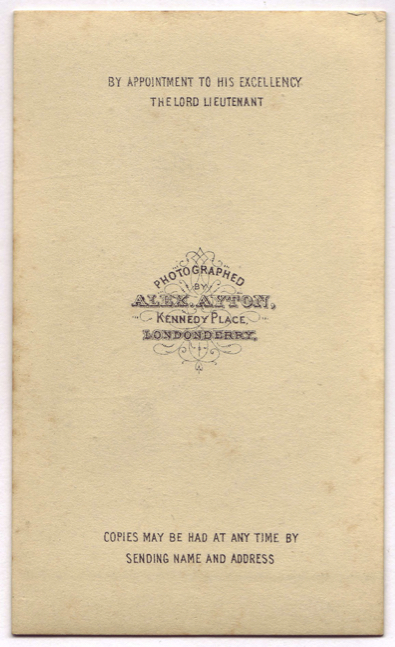
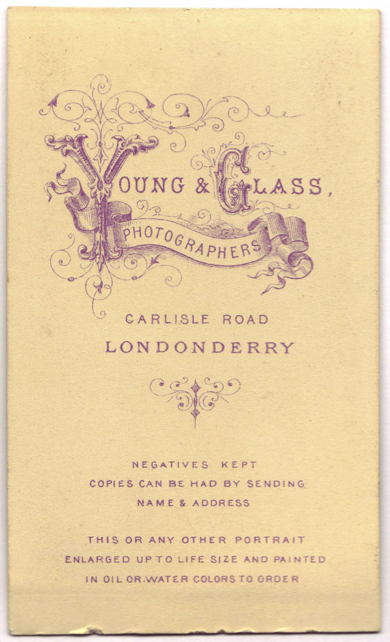
james glass had arrived in derry around 1861 with his father alexander glass, who in 1858 was farming 16 acres in the townland of ballyboe glencar in conwal parish, county donegal, just to the north of letterkenny. in the city of derry james glass was first apprenticed to alexander ayton who had a photographic studio at kennedy place in the city, with glass later establishing his own studio in the city, firstly in partnership with young and then alone.


with the photographic practices of glass and mckinney as the key agents within our analysis, we are therefore equipped to interrogate the strategic function (i) for the medium of photography, the function of photography as a formation determining linkages between perception, meaning and the construction of identities, the function of photography as a perceptual apparatus with the capacity to capture, orient, determine, intercept, model, control, or secure the gestures, behaviors, opinions, or discourses of living beings, here across the discourses of the presbyterian communities within mid to late 19th and early 20th century ulster and their agency within that period, and across the antiquarian, archival, institutional and technological frameworks within which we now engage with these practices.
in “the confession of the flesh” foucault notes that “i understand by the term “apparatus” a sort of–shall we say–formation which has as its major function at a given historical moment that of responding to an urgent need” (ii)
to interrogate the urgent need which this apparatus answers we can explore how the aesthetics, ethics, technologies, beliefs, economies, laws, customs, loyalties, affiliations of the presbyterian communities of late 19th and early 20th century ulster are refracted through the prism of the photographic practices of glass and mckinney.
notes:
(i) & (ii)
foucault defined his use of the term dispositif (apparatus) in 1977:
what I’m trying to pick out with this term is, firstly, a thoroughly heterogenous ensemble consisting of discourses, institutions, architectural forms, regulatory decisions, laws, administrative measures, scientific statements, philosophical, moral and philanthropic propositions–in short, the said as much as the unsaid. Such are the elements of the apparatus. the apparatus itself is the system of relations that can be established between these elements.
secondly, what I am trying to identify in this apparatus is precisely the nature of the connection that can exist between these heterogenous elements…
between these elements, whether discursive or non-discursive, there is a sort of interplay of shifts of position and modifications of function which can also vary very widely.
thirdly, I understand by the term “apparatus” a sort of–shall we say–formation which has as its major function at a given historical moment that of responding to an urgent need. the apparatus thus has a dominant strategic function. (“the confession of the flesh” (1977) interview. in power/knowledge selected interviews and other writings (ed colin gordon), 1980: pp. 194-228. this interview was conducted by a round-table of historians.)
 the empire of the senses