speculation on the relation and non-relation of elements within, between and across the photographs of william fee mckinney and james glass has the capacity to engage in genealogies of the radical, as variable traces made visible in the social, political and cultural frameworks displayed within their photographs and the social, political and cultural framework of the display of their photographs.
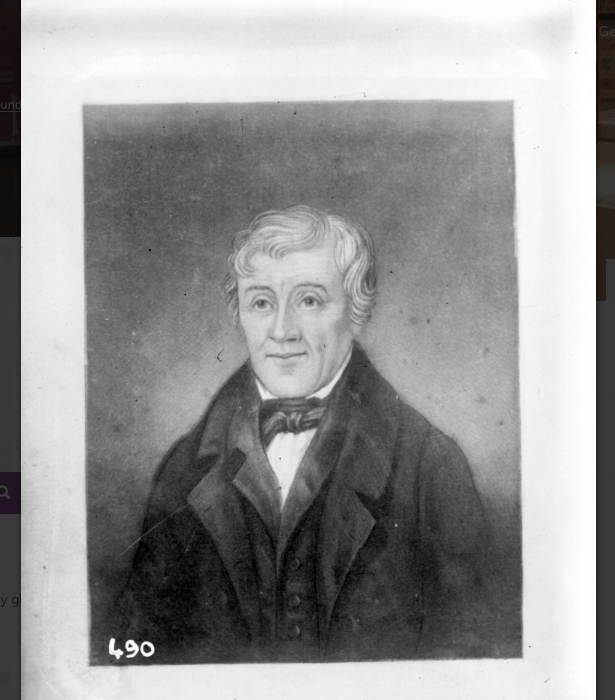
as an example, this photograph above the title by william fee mckinney (from the nmni collection – https://www.nmni.com/collections/history/photographs/dundee–mckinney-collection/hoyfmdundee490)
this is a photograph of a portrait of james hope (1764-1847), an antrim-born united irishman, from a series of engravings of prominent leaders of the united irishmen, produced for a book by madden on the subject published in the 1840’s. mckinney has photographed this portrait and stored within his albums, within a cultural framework wherein photograph albums served to contextualise the individual within genealogical, cultural, and familial histories (i), thereby contextualising mckinney, his kith and kin featured in the surrounding images, within some affiliation for james hope.
hope in facts stands somewhat apart from his fellow united irishmen and their legacies. he was of markedly lowly stock compared to many of his contemporary united irishmen, one of the few working men to attain a position of influence in the united irishmen … (and) … drawn to the united irish movement as a means of securing radical social change (ii), markedly aware of what we could call the class and socio-economic basis for radical and revolutionary action. some forty years after the united irishmen rebellion of 1798, james hope wrote:
there are circumstances which should be kept always before one connected with the events of 1798, to which their production is mainly attributed. as a people, we are excluded from any share in framing the laws by which we are governed. the higher ranks usurped the exclusive exercise of that privilege, as well as many other rights, by force, fraud, and fiction. by force the poor were subdued, and dispossessed of their interests in the soil; by fiction the titles of the spoilers were established; and by fraud on the productive industry of future generations the usurpation was continued… it was my settled opinion that the condition of the labouring class was the fundamental question at issue between the rulers and the people, and there could be no solid foundation for liberty, till measures were adopted that went to the root of the evil, and were specially directed to the restoration of the natural right of the people, the right of deriving a subsistence from the soil on which their labour was expended.
although james hope does stand as a class apart, and his socio-economic radical analysis sets him distinctly apart, from many in the united irishmen, and furthermore some of other local veteran united irishmen characterised as kith and kin by mckinney in his diaries had by the first decade of the 1800s become apparently ‘reformed characters’ voting for the act of union by 1801, this should not give the impression of any period of social, industrial and constitutional stability within mckinney family’s parish of carnmoney across his parent’s adult years, and his own early childhood years, the first decades of the 1800s. as outlined in the view from the ground of the mckinney family parish of carnmoney, from the ordnance survey memoirs of ireland, volume two, parishes of county antrim (i), 1838-9, ballymartin, ballyrobert, ballywalter, carnmoney, mallusk (i), in the account of carnmoney provided in the memoir by james boyle, 28th april 1839 we see in carnmoney a community in state of flux, featuring a period of serious industrial dispute in the area, following a rapid economic boom within a new industry and its new industrial technologies, and then a sudden impact on the economy of the community from new transport technologies, followed by ‘combination’ – nascent unionised activity amounts, when workers began to ‘combine’ or take a collective approach in an attempt to protect their interests. nb in the texts below the terms ‘printing’ and ‘printers’ refer to workers printing patterns etc onto textiles within the cotton trade:
manufactories and machinery: the manufactories and machinery of this parish consist of 5 establishments for spinning linen yarn, 1 establishment for printing cottons, 1 log wood mill, 1 threshing machine, 3 corn mills and 2 flax mills (47)
importance of cotton manufacture: in 1786 the first cotton manufactory in ireland was established in the adjoining parish of shankill and on the verge of this parish, by the late nicholas grimshaw esquire, who had previously come from england and settled in this parish. he soon after established the very extensive cotton printing and spinning manufactories which had until the year 1834 been carried on by his sons, and was the first to establish in this country a trade in which so much capital from this county has been embarked. the introduction of the cotton trade into carnmoney laid the foundation of the great improvement which it has since undergone. the extensive employment the manufactories afforded not merely occupies the few unemployed labouring people in this, but attracted numbers from the surrounding parishes to such a degree that the populous villages of whitehouse upper and whiteabbey are to them indebted for their origin and erection. the wages then given to printers and others were most liberal. the consumption of provisions and farm produce was of course materially increased, capital was more freely circulated in the parish and a stimulus was given to agriculture in consequence of the increased consumption of farm produce. (my emphasis) (51)
reasons for decline in cotton industry
the first check which was given to the prosperity of the cotton trade in this country was by the more general introduction of steam navigation, owing to which, principally, the trade has almost entirely left the country, and now there is not in reality a market for cotton in ireland. the cotton goods consumed in this country are purchased chiefly in manchester, which market has quite absorbed the irish ones. …
another and a main cause of the destruction of the printing business in carmoney, and that which eventually compelled its abandonment by the messrs grimshaw, was the system of combination which had existed among the workmen, but chiefly among the printers. combination had first appeared about 30 years ago, but it was not until the last 15 or 16 years that it assumed a systematic appearance or became by any means formidable. several strikes had taken place among the printers, and their obstinacy in refusing to come to terms was encouraged by the assistance which they received from ‘the trade’, and by the facility which they had for emigrating to england or scotland by the belfast steamer. latterly the system became so formidable and the annoyance and losses which they sustained by it became so serious that the messrs grimshaw in 1834 gave up the printing business, converted some of their cotton spinning machinery to that for the manufacture of linen yarn and let one of their mills to messrs bell and calvert. (52)
(i) Nicole Coffineau (2017) Alessandro Pavia’s Album dei Mille: Collection, Archive, and National Identity during the Risorgimento, History of Photography, 41:1, 61-75, DOI: 10.1080/03087298.2017.1292650
(i) https://www.historyireland.com/18th-19th-century-history/the-dog-that-didnt-bark-the-north-and-1803/
(ii) the ordnance survey memoirs of ireland, volume two, parishes of county antrim (i), 1838-9, ballymartin, ballyrobert, ballywalter, carnmoney, mallusk, pub the institute of irish studies, belfast & the royal irish academy, dublin, 1990
 the empire of the senses