
albums, facticities and fictions iii (Elements of photography viii)

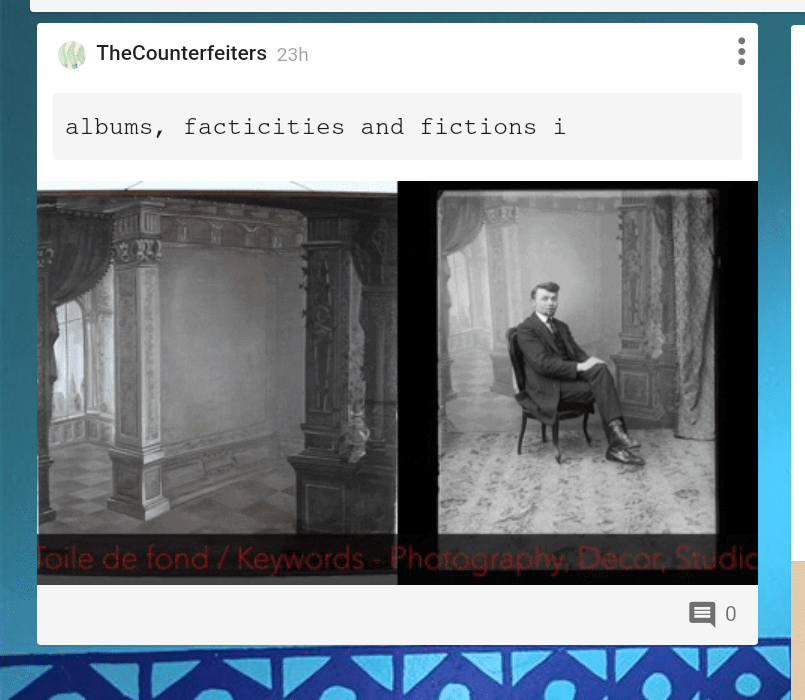
Backdrops depicting "a covered lookout at water's edge, a library room, decorative screens, an outdoor garden scene, a room with a piano, a picture and mantle, a window next to bookshelves'. Circa 1890. Photographed in Tallahassee, Florida between 1885 and 1910. Alvan S. Harper collection (Alvan S. Harper collection Bendann Brothers). Images courtesy of Florida Memory, State Library and Archives of Florida. Rephotographed at The Dollhouse Space, 2020.

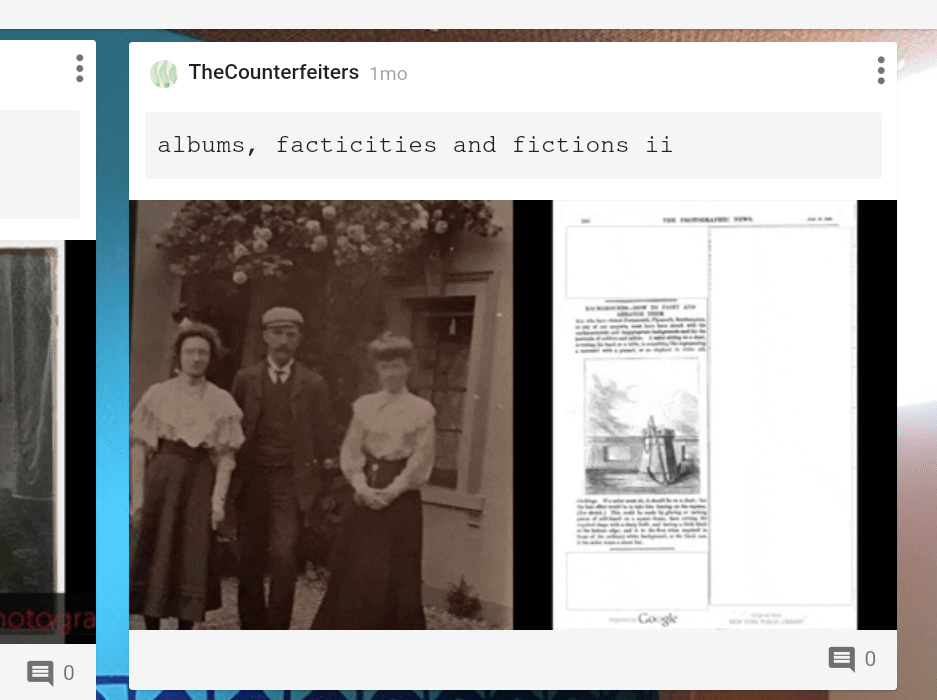
A series of articles on 'BACKGROUNDS - HOW TO PAINT AND ARRANGE THEM' like the one below in albums, facticities and fictions ii appeared in The Photographic News across late 1859 and early 1860. The series instructed on the creation of both fictional interiors and exteriors:  for example, "A rustic background for ladies in walking dress, with dark foliage at the side for light-haired children, may be constructed with great artistic effect ..." (issue of Jan 20, 1860). Marien (1998) and Steve Edwards (2006) are two of the several authors who indicate how an interrogation of the nineteenth-century printed literature of photography can be central to an understanding of the discourse of early domestic photography,  in their analysis of a a plethora of the early trade journals of photography. This analysis indicates that the visual economy of the Victorian era developed within and through the social and cultural capital of photography as an emerging profession, situating what Edwards describes as the ‘ideological space of the studio’ as central to the making of meaning in nineteenth century photography (Edwards, S. 2006: 251), with Edge (2017) noting that ‘Gender- and class-based codes’ were ‘communicated via the inclusion of backdrops and props’ (Edge 2017:40) in practices of high-street photographers. Central to how this ideological space of the studio operated is the potential challenge to and fracture of the defined positions of social capital and its representation - through potentially common sequences of display within a domestic photo album, or display in an on-street public window of a photographer’s studio, in which a photographic portrait of a commoner could be displayed adjacent to the (commercially published) photographic portrait of their superiors (Edwards 2006:247-248; Plunkett 2003). And allied to this argument, Edwards (2006) and Plunket (2003) indicate a reading of the early photographic studio as a threatening arena wherein a subaltern may adopt within their pose and selected studio backdrop the visual registers of their superiors. In early studio photographic portraiture this unregulated fluidity in the representational tropes of social status was made overtly possible, with for example the potential for a ‘commoner’ to choose to be photographed against a studio painted backdrop and constructed studio ‘set’ of a country estate, as one of the many common options from the range of various painted backgrounds adopted in studio portraiture. Following arguments delineated by Edwards (2006), my research indicates the complexity and paradoxes of early domestic photography by reading the domestic photograph albums of William McKinney through the prism of the professional photographic portrait studio practice of James Glass.
 the empire of the senses