
contemporary and historical perspectives which reinforce a sense that across the latter half of the nineteenth century the western counties of ireland and westernmost county of ulster served as sites for repeated instances of observation and survey – what could be described as open laboratories for processes of interpellation – are broadly discussed across a range of literatures: for example from twentieth century academic biography referenced via twenty-first century local history:
the subject of deprivation in ireland preoccupied the british authorities for the greater part of the nineteenth century; it was the main issue addressed in all government reports between 1887 and 1890. (i);
to a contemporary account from within late 1800’s ulster such as schoolteacher hugh dorian’s ‘history from below’, outlining within the specific language of vision and visibility the contemporary popular consciousness of the population being a locus of observation and survey:
at the present time, 1889, all eyes of feeling christians of the united kingdom and of many parts elsewhere are directed towards donegal (ii).
furthermore, as dorian continues within his own footnotes to outline briefly the specific land war events of that year of 1889 which had led to this particular experience of observation, he uses again within his account the language of vision and specifically the language of visibility as witness, indicating that within this social framework judicial actions specifically functioned as instances of display, and that such actions were experienced through visual metaphor and visual analogy, and all at a geographical reach across a large province such as ulster:
priest and peasant, the old man, the sturdy youth and the blooming maid, taken prisoners, marched between two file of soldiers from gweedore to derry gaol. anyone who had seen witnessed the procession from pennyburn to bishop street queen’s hotel, can never forget it …it could not be compared to roman victory or procession in days of paganism. it was more like hell opened until the iron gates closed upon their prey … (iii)
and so a set of land war events in the western edges of ulster are not only reported within contemporary print media, but also refracted as spectacle on the streets of ulster’s second city derry.
and the specific set of land war events in the western edges of ulster reaches further still, refracted again within the spectacle of a ‘massive indignation meeting’, in fact ‘one of the finest meetings ever held in the city’ within the ulster hall in belfast in february 1889, discussing these specific distant land war events in the western edges of ulster as part of the broad contemporary debate about the issue of land and home rule, and discussing the events once again within the language of display and appearance, with a reverend kane projecting in his speech from the podium for his assembled audience a fixed image, declaring that the people of the gweedore region were ‘ as innocent and credulous as the painted children of the prairie’ (iv).
and in terms of photographic practice within ulster in this period, contemporary photographs of living conditions within the region of gweedore by the derry photographer james glass also now gain further traction with one photograph copied as a graphic to feature on the cover of a liberal reformist’s pamphlet on the issue of land and home rule and the events within the gweedore:


![L 440-2[1].](https://theempireofthesenses.com/wp-content/uploads/2018/01/l-440-21.jpg?w=1000)
and another of james glass’ photographs of the setting of these specific land war events presented and annotated as visual evidence – a theme to which we shall return – included within the pamphlet itself (v):
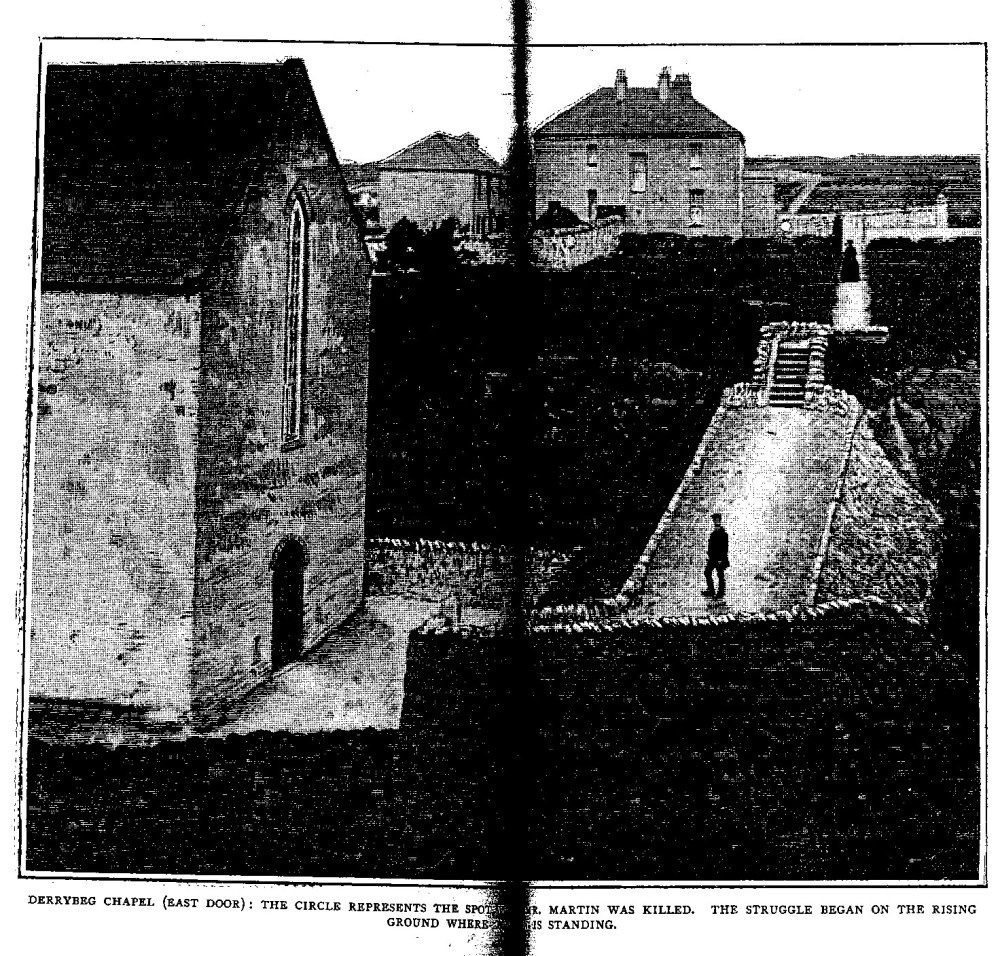

(i) Arthur Balfour’s Tour of Donegal (1890) by S. Beattie in ed. S. Beattie, Donegal Annual: Journal of the County Donegal Historical Society No.57, Donegal, 2005 referencing Catherine B. Shannon. Arthur J. Balfour and Ireland, 1874–1922. Washington, D.C.: Catholic University of America Press. 1988
(ii) and (iii) ed. Breandán Mac Suibhne and David Dickson, The Outer Edge of Ulster: A Memoir of Social Life in Nineteenth-Century Donegal by Hugh Dorian. Notre Dame, University of Notre Dame Press, 2001
(iv) from the belfast newsletter, 15 feb 1889, discussed in Breandán Mac Suibhne and David Dickson.
(v) images from the NMNI collection specified as the James Glass Album, and the publication H. W. Massingham, The Gweedore Hunt: A Story of English Justice in Ireland, London, 1889.

