
part of the initial impetus to this research across two contemporaneous late 19th/early 20th century ulster photographic practices (james glass and william fee mckinney) was the potential to research themes and tropes reflected or refracted between them. as examples: a studio photographer and an amateur photographer, the north-west and the east of ulster, the contested national identity within derry and the solid national identity within county antrim, the ‘genres’ (to borrow the terminology of critic karen strassler, see below) present across their photographic practices of studio portraiture, social document, family album.
that notion of refraction is engaged with by karen strassler in her research into photography, identity and national identity in java across colonial and post-colonial periods. speaking of the bodily pose within the framework of studio portraiture as a ‘genre’ she writes
this bodily molding anticipates being seen by others and is a bid to be recognized in a particular way. as subjects of photographs, people both appropriate available image-repertoires to stake claims to particular identities and social positions and, at the same time, are subjected to ideologies and narratives attached to these visual appearances that are not entirely of their own making. the term “ refraction” also illuminates the processes of redirection and transformation that occur as ways of seeing, modes of interpretation, and habits of practice attached to one photographic genre or representational form refract within another.(i)
and to use even only the images that we have already encountered within this blog, we can still ask could such refraction be functioning here:

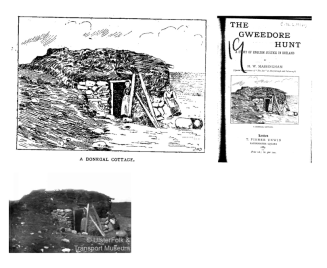
(l. william fee mckinney photograph / r. james glass photograph and copy in campaigning land war pamphlet / see blog entries below for more details)
there is in the most simplistic sense some presence of habitat/property and inhabitant shared across all these images. in fact it is it is crucial to acknowledge how opaque or transparent such an instinctive reading is, and what such opacity or transparency may itself indicate. what is striking for now is that each of these images resonates not just with habitat/property and inhabitant as a platonic ideal, but rather within what could be called a range of refraction for the thematic of place/home/family that functioned as a central trope across late nineteenth-century ireland:
haunted by the ubiquity of displacement and family disintegration, the irish popular mentality nurtured as a counterpoise a fierce sense of place, home, family. any forces which threatened this trinity destabilised the equanimity of the popular imagination. (ii)
while the james glass photograph of ‘view of ruinous gweedore dwelling with occupant’ may be the kind of visual sign that we would expect to see constructed from within that central trinity of place/home/family in the popular mentality in late nineteenth-century ulster, it is vital to acknowledge the status of this photograph as the visual survey of an outsider, and to question the relationship and the refraction between the language of display and the function of making a photographic social document (which was not the primary photographic genre exercised by james glass), and the language and function of making a photographic portrait (which was the primary photographic genre exercised by james glass).
and while the line-drawing copy in massingham’s campaigning pamphlet of james glass’ ‘view of ruinous gweedore dwelling with occupant’ may be the kind of visual sign that we would expect to see constructed from within that central trinity of place/home/family in the popular mentality in late nineteenth-century ulster, it is vital to acknowledge its lineage as the visual survey of a series of outsiders, first the photographer as outsider, then author as outsider and then copying artist as outsider , and to examine within the image the refraction of meanings, intent and agency for the photographer, for the photographic subject and for the author/campaigner and the copying artist.
the william fee mckinney photograph of a social gathering at sentry hill in county antrim may not be the kind of visual sign that we would expect to relate to the discussion of eviction and the attendant central trinity of place/home/family in the popular mentality in late nineteenth-century ulster. however, in this photograph, can that destabilising central threat of eviction, that central trinity of place/home/family in the popular mentality in late nineteenth ulster be seen refracted across ulster west to east? mckinney’s photograph is, as already indicated below, part of the informal socialization of elite groups but it also functions to identify the central trinity of place/home/family for an ulster presbyterian community in the era of the land war, to display their own secured connection to their place for an ulster presbyterian community in the era of the home rule crisis.
(i) karen strassler, refracted visions: popular photography and national modernity in java, duke university press, 2010, p26
(ii) kevin whelan, eviction, in ed. wj mccormack , the blackwell companion to modern irish literature, oxford, 1999 quoted in l. perry curtis, the depiction of eviction in ireland 1845-1910, dublin, ucd press, 2011, p24
 the empire of the senses