#singingstones

Our satellite summer project Singing Stones began its research in archives and onsite this August in West Donegal.

In Singing Stones the artist Cathal McGinley and the curator/researcher Declan Sheehan are making new work with the stone featured in fragments of Irish archives – from maps, to newspapers, to hunger and welfare, crime and punishment, performance and art.

Look out for #singingstones online and onsite in West Donegal, as part of Cathal McGinley’s open studio at An Gailearai in Gweedore from September to mid October 2020.

There’s a first extraction from the archives on the project’s Facebook link here: Messrs. RICHARDSON will perform, for the first time in this country, on their newly-invented and most extraordinary Instrument, THE ROCK HARMONICON


The Yalta Game: Myrid Carten, Susan MacWilliam, James Glass

Installing exhibition The Yalta Game at the RCC gallery, Donegal, which features work from Myrid Carten, Susan MacWilliam and my curatorial research on James Glass.

Install pictured above and below still awaiting final edits of digital material on James Glass and Myrid Carten’s new three-screen projection piece, WEB.

Opens next week. http://regionalculturalcentre.com/event/the-yalta-game-myrid-carten-susan-macwilliam-and-archive-photographs-of-james-glass/?fbclid=IwAR1G-PbWZP6l8Bb8LVAjwYmik1c8DeZ9HX19ffOyJzFCCe9Vb6mJF5qZ5hA

Image from work visible in photographs below is a still from: Susan MacWilliam, KATHLEEN, 2014, 33 mins

(NOTES FROM AN) OFFICIAL LIST OF RADICAL ACTIVISTS AND SUSPECTED ACTIVISTS INVOLVED IN EMMET’S REBELLION, 1803 (NB. rebellion date 23 July 1803)

‘Hope, James. About 5 feet 7 in[ches] high; black hair & eyes; long faced; ill looking; has a stoop in his shoulders. Speaks with the northern accent and is about 40 years old. Comes from the co[unty] Antrim somewhere near Belfast. [William Putnam] McCabe [qv] & Hope organized the greater part of the country in 1798. McCabe told Quigley that Hope was the most active man he ever met. [f. 41v] Hope went to Drogheda with a view of effecting a rising in conjunction with [George] Teeling [qv]. Kept a linen shop in the Coombe. Is the person who communicated with the Executive [qv]; must know them all. He went twice with Russell to the north. Supposed to be now in the Liberty. No man can convict Ph[ilip] Long [qv] except Hope; Hope assisted McCabe in organiz[in]g the country in 1798’

The passage above is from a ‘ ‘notebook’  … (this is how it is described in the catalogue of the National Library of Scotland) … a sort of prosopography of Irish radicalism … (which) was prepared as part of (the) process  (of) gathering information to establish an accurate picture of the plans (for the insurrection) that had been hatched and the name, position and actions of those responsible …  not signed, but it can confidently be ascribed to Charles William Flint, the private secretary to the chief secretary, William Wickham; it was assembled in the autumn of 1803.’

(Note: ‘James ‘Jemmy’ Hope (1764-1847) from Templepatrick, county Antrim, was an exceptional promoter and recruiter for the cause of the United Irishmen in the 1790s. Having seen action in county Antrim in 1798, he was committed to a further effort and he was one of Emmet’s most committed organisers in 1803. Sent north with Russell, he avoided apprehension and subsequently melded back into civilian life’.)

(All of the above from:

KELLY, J. (2012). OFFICIAL LIST OF RADICAL ACTIVISTS AND SUSPECTED ACTIVISTS INVOLVED IN EMMET’S REBELLION, 1803. Analecta Hibernica, (43), 129-200.

Retrieved from http://www.jstor.org/stable/23317181)

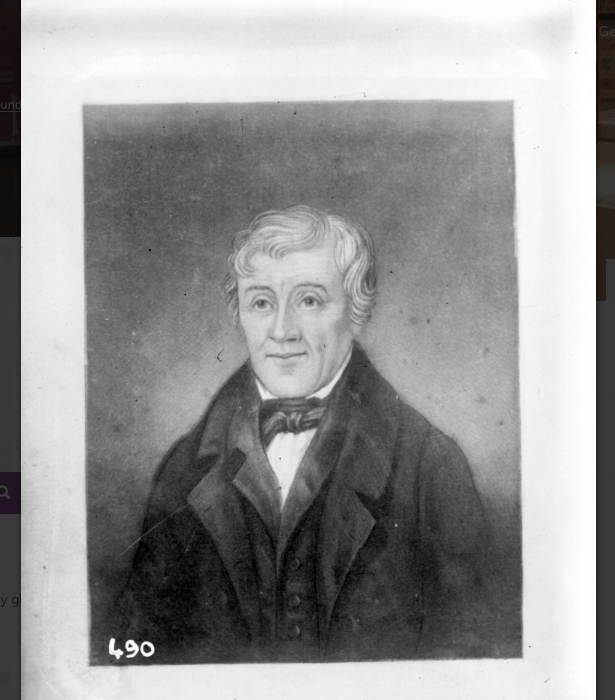
(Featured image is a photograph made by William McKinney of a sketch, see below, the photograph held and displayed by McKinney in his albums, specifically ‘Box 1 Album 1 Large dark leather album with clasp and a tooled design of a country scene with a bird and a butterfly’; the glass plate negative of this photograph now held in the collection of NMNI.)

See also from other contemporaneous sources:

This slideshow requires JavaScript.

the gentleman who pays the rent

The animal was widely referred to as ‘the gentleman who pays the rent’, because he was fattened all year to be sold at market, and the proceeds of the sale traditionally provided rent money. (Claudia Kinmonth, Irish rural interiors in artNew Haven and. London: Yale University Press, 2006, p111)
As in the previous posting, here again, in deciding in this instance to curate the photograph albums of William Fee McKinney as folklore, we can read the photographs of McKinney against the grain, that is against the legend which McKinney provides as the only description accompanying these photographs – Tom Couley, Pig Killer, c.1895.

Whilst reserving the strategy of also interrogating these particular images as part of McKinney’s apparent typology of rural workers, we can here also indicate in McKinney’s  Tom Couley, Pig Killer, c.1895 photographs a subaltern counter memory, we can indicate a performance and a trace of a concurrent stereotype seized upon by critics of Irish society, who liked to lampoon ‘the pig in the parlour’  and the position of the featured animal, as opposed to the featured human subject Tom Couley, as a central figure of the age, ‘the gentleman who pays the rent’.

This slideshow requires JavaScript.

In the poor rural nineteenth-century home, the pig lived indoors, on the same boiled potatoes, as the rest of the family … By the nineteenth-century the pig as a ubiquitous addition to most rural households was commented on by virtually every traveller to Ireland. The more perceptive writers recognised that it was just the most fortunate farmers who kept a pig: Gustave de Beaumont observed in 1839:

From Gustave de Beaumont, Ireland: Social, Political, and Religious, vol. 1 [1839]: “The physical aspect of the country produces impressions not less saddening. Whilst the feudal castle, after seven centuries, shows itself more rich and brilliant than at its birth, you see here and there wretched habitations mouldering into ruin, destined never to rise again. The number of ruins encountered in travelling through Ireland is perfectly astounding. I speak not of the picturesque [266]ruins produced by the lapse of ages, whose hoary antiquity adorns a country—such ruins still belong to rich Ireland, and are preserved with care as memorials of pride and monuments of antiquity—but I mean the premature ruins produced by misfortune, the wretched cabins abandoned by the miserable tenants, witnessing only to obscure misery, and generally exciting little interest or attention.

But I do not know which is the more sad to see—the abandoned dwelling, or that actually inhabited by the poor Irishman. Imagine four walls of dried mud, which the rain, as it falls, easily restores to its primitive condition; having for its roof a little straw or some sods, for its chimney a hole cut in the roof, or very frequently the door, through which alone the smoke finds an issue. One single apartment contains the father, mother, children, and sometimes a grandfather or grandmother; there is no furniture in this wretched hovel; a single bed of hay or straw serves for the entire family. Five or six half-naked children may be seen crouched near a miserable fire, the ashes of which cover a few potatoes, the sole nourishment of the family. In the midst of all lies a dirty pig, the only thriving inhabitant of the place, for he lives in filth. The presence of the pig in an Irish hovel may at [267] first seem an indication of misery; on the contrary, it is a sign of comparative comfort. Indigence is still more extreme in the hovel where no pig is to be found.” [Gustave de Beaumont, Ireland: Social, Political, and Religious, vol. 1 [1839]]

The animal was widely referred to as ‘the gentleman who pays the rent’, because he was fattened all year to be sold at market, and the proceeds of the sale traditionally provided rent money. 

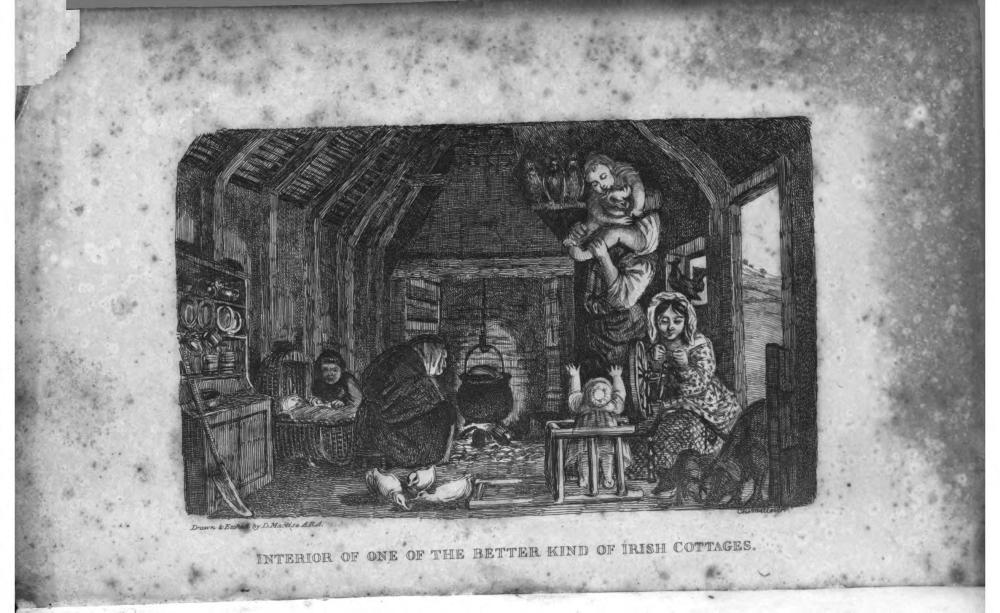
Interior of one of the better kind of Irish cottages, Daniel Maclise, 1836

Interior of one of the better kind of Irish cottages, Daniel Maclise, 1836

 illustrations bear witness to the pig as a common occupant of the kitchen. Maclise shows him wandering through the open door … Although his presence was a stereotype seized upon by critics of Irish society, who liked to lampoon ‘the pig in the parlour’. Maclise had no such hidden agenda, and was undoubtably relating what he was familiar with. 

(Claudia Kinmonth, Irish rural interiors in artNew Haven and. London: Yale University Press, 2006, p111/112)


Bliain na bhFranncaigh – bhí ‘n foghmhar go luath, bliain bhréagh a bhi inti

“In the year of the French the harvest was early and the weather was fine”

Here, in deciding in this instance to curate the photograph albums of William Fee McKinney as folklore, we can indicate in his harvest photographs a subaltern counter memory, a performance of remembrance and commemoration of rebellion, a trace of how ” 1798’ provides a classic example of an Irish Lieu de Mémoire – a site of collective memory – transmitted and transmuted through song, story, stone and commemoration  … in the agricultural calendar, the invasion coincided with the harvest season. It was remembered that the French came in to Killala “on a fine harvest day” and that “Bliain na bhFranncaigh – bhí ‘n foghmhar go luathbliain bhréagh a bhi inti” (in the year of the French the harvest was early and the weather was fine) … the multiple temporal perspectives in folk history present cubist portrayals of the past …

This slideshow requires JavaScript.

The kaleidoscopic nature of time and calendar in social memory poses a challenge to standard historic periodization, which presumes to authoritatively date events along a set linear sequence … To paraphase Kark Marx, in social memory “all that is solid melts into air” and the remembrance of the Year of the French as not merely a straightforward chronology of all the events that happened (in Connacht) over a month in the late summer of 1798. Overall, the field of Irish folk history evidently had distinct characteristics, both in its variety of form, contexts of performances, practitioners, and modes of temporality. All this should be kept in mind when examining the content of collected folklore sources, a task that may illustrate more specifically how the Year of the French was remembered. … “(Guy Beiner, Remembering the Year of the French : Irish Folk History and Social Memory, Madison: University of Wisconsin Press, 2007, p134/135 )

We should remember that William McKinney’s own writings reflect upon how both his grandparents joined the United Irishmen who at first united only on reforms being made in the existing government without any intention of fighting…. (Brian Walker, Sentry Hill: An Ulster Farm And Family, Dundonald, Blackstaff, 2001) The commemorative Bastille jug for which William Fee McKinney had ensured a photographic record, had entered the McKinney family through his grandparent’s generation, through the figure of United Irishman John McKinney. It commemorates and celebrates the French Revolution. William McKinney’s grandparents grew up in the era of the French Revolution. In 18th century Ireland, many Ulster Presbyterians looked to the French example and the new political ideas of ‘liberty, equality and fraternity’. They also supported the Society of United Irishmen who sought to plant these ideas in Ireland. In June 1798 John McKinney had carried the signal for local United Irishmen to rise and march on Antrim town but the rebellion failed, and in fact William’s great-uncle, Samuel George, was killed at the Battle of Antrim. Traces of how the United Irishmen, 1798 and this battle were commemorated visually are visible within the collection and photography of  William Fee McKinney. The artist JW Carey was a figure present, even in a secondary sense, in the social circle of McKinney, providing illustrations for a book on United Irishman William Orr by McKinney’s friend and distant relative the antiquarian Francis Bigger . JW Carey had “… established in Belfast a graphic design office which provided illustrations of historical scenes for antiquarians  … visual representations of oral traditions … Carey’s paintings (of the United Irishmen battles of 1798) reflected a subaltern counter memory, which could not be put on canvas until many years after the event … ” (Guy Beiner, Forgetful Remembrance: Social Forgetting and Vernacular Historiography of a Rebellion in Ulster, OUP, 2018, p 325/326, 556/557). Benier also points out that McKinney retained in his collection at Sentry Hill pikes and muskets from the time of the United Irishmen rebellion.

The defeat of the United Irishmen,of course “did not mean the end of their ideals, and Dr William Drennan, coiner of the principles of the United Irishmen, was a founder in 1810 of the Belfast Academical Institution, among whose aims was demonstrably the continuation of revolution by other, educational, means as articulated in Drennan’s wish that: ‘ a new turn might be given to the national character and habits’ …” (David Cairns & Shaun Richards, Writing Ireland: Colonialism, Nationalism, and Culture, Manchester, Manchester University Press, 1988, p22) and it is therefore noteworthy that subsequently, for three generations, the McKinneys selected this Belfast Academical Institution as the primary educational influence upon most of the young sons within the McKinney family, with two of William Fee McKinney’s brothers and all of his own sons and several of his grandsons being taught there.