Uncategorized
theatre
One of the reasons that the definitive interpretation of the McKinney photograph albums may seem problematic is that the albums have a kind of oscillation as their character or at their core. There does seem to be one an overarching framework for the albums, that of the domestic, which is communicated in the readings provided by substantial texts on the collections such as that of Walker and the reading provided by the institutions circulating the collection, that is NMNI, the Sentry Hill Museum and PRONI. And yet we can indicate traces prompting multiple possible readings of agency made apparent across the albums – for example as a typology or as a document or as a series of still lifes. To interrogate this, three arguments are necessary here: the domestic in photography itself; what has been termed as the surface and how what has been termed as the ‘dense context’ (Edwards, see below) both function within photography; and the traces prompting multiple possible readings of agency made apparent across the archive albums – for example as a typology or as a document or as a series of still lifes.
There are the surface readings and surface level assurances regarding any domestic family album circulated in the descriptions and textual exegesis of McKinney’s photographs from his albums in websites, catalogue entries and books provided by NMNI, PRONI and Walker. The problematic of this framework of readings being circulated and communicated is best interrogated by Edwards when she outlines how the context of a photographic object is often articulated as a closure of meaning for it, how the description of “the who, what, why and where of the making of the photograph and the portrayal of its content” (Edwards, Negotiating Spaces, p262) results in a closure of meaning. In my earlier posts I have referred to an ‘originary agency’ for a photograph album as only one of several possible modes of agency apparent in and through any archival photographic object, and Edwards refers to how a closure of meaning is sometimes derived from this “ ‘functional’ or ‘originating’ context … that this is the context that defines the creation and existence of the photograph, anchoring it as a functional document/object.” (Edwards, Negotiating Spaces, p262)
Both Edwards and others argue that in exploring the domestic family album, both the visibility of presence and the erasure of absence are central in constructing meaning. One of the questions that these that we must return to often is “what does ‘being in the album mean, and, conversely, what does not being there mean” (Richards Chalfen, Snapshot versions of life, p11) Crucially, Edwards expands on this meaning of the absent to outline the function of what she terms as the “dense context”. The “not necessarily apparent” (Edwards, Negotiating Spaces, p263) of what the photograph is of communicated as an integral part of the layering of meaning in an event and a representation, the function for what is absent within an event and its representation within the construction and circulation of its meaning.
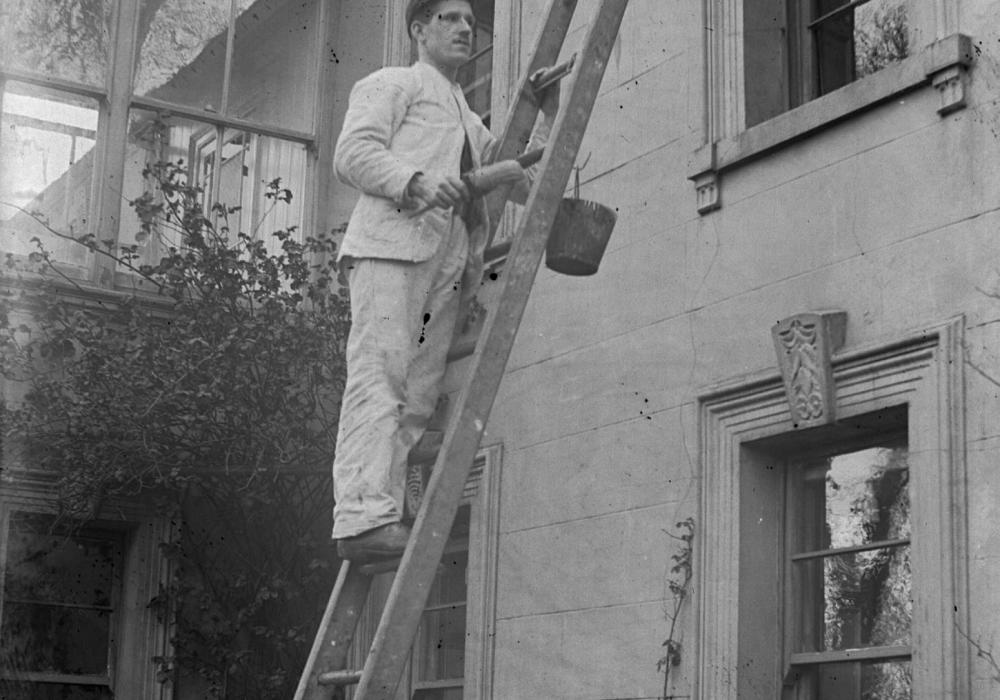
Although Chalfen’s interrogation of photograph albums focusses upon late twentieth century ‘snapshot’ culture, his commentary can still engage as a provocation within a reading of an archival photographic collection. Where Chalfen notes the ubiquity of participation within his contemporary society of the practice of domestic photography, ‘Cameraless people often become part of other’s home photography (and are given pictures of themselves). They can also have personal pictures made in … inexpensive studio settings” (Richard Chalfen,Snapshot versions of life, p.15) this comment can also serve to indicate a power dynamic seemingly obscured by its overt visibility – that relationship between the photographer and the subject, in our case here, the decision made by the photographer McKinney to document his subject. Where and with whom, is the agency in this practice? What is the power relationship? Are there signs that mean it can it be read as an negotiation, collaboration or exchange or an imposition, demand or coercion of unequal relationships? What can be indicated if we follow Edwards when she writes of specifically “thinking through” nineteenth-century photographs to indicate and interrogate the “nineteenth-century performance of space, identity and power”, thinking beyond the “forensic content of the images themselves”. (Edwards, Negotiating Spaces, p261). Some examples here from the McKinney albums are the several photographs of tradesmen at work within the grounds of McKinney’s Sentry Hill homeplace. Two of these phototographs and their description feature the selected subjects both at rest and active at work specifying an intent to include the act of work within this image (and perhaps even this could be termed as within this series, and the potential to discuss these photographs as a series and a typology will be explored later) and here it is enough to indicate that there is some transactional relationship within the act of photography – the power of a commercial exchange from payer to payee.
There are other photographs that feature the practice of work and workers at Sentry Hill. However for these above what we need to indicate is that although, as Edwards comments, “power itself is too crude an instrument for measuring all the subtleties that make up the interaction within (these) photographs, for just as many meanings coexist in one photographic image, so many spaces coexist in one physical space” (Edwards, Negotiating Spaces, p276), power is one of the relationships that is communicated in these photographs, and we can indicate this power relationship of a commercial exchange as part of the ‘originary agency’ or ‘functional’ or ‘originating’ context in these photographs. In this domestic homeplace the photographer, landowner, landlord has superior social and economic capital than these manual workers.
We know also that Caldwell, the labourer, also featured in one of these photographs, was in fact also a tenant at Sentry Hill and like several of the McKinney’s tenants at Sentry Hill could partially pay for his rent through such work at the farm for McKinney. (Walker, Sentry Hill, p115)

These photographs do not feature commercial relationships or the power of a commercial exchange from payer to payee in which the photographer is in an equal of inferior position, such as making payment to a representative of the state or negotiating with a bank manager or a member of the medical profession.
This choice in displaying one form of commercial relation, one set of social relations and social status, in these photographs can further indicate agency for the Sentry Hill albums of photographs if we follow Chalfen who asks “What do ordinary people do with their personal pictures, and in turn, what does this imagery ‘do for’ ordinary people. … Any study of communication must attend to human involvement in both sides of the message form – production of the message and reception of the message … as encoding and decoding … how ordinary people interpret or reconstruct the rendition of life that is repeatedly presented in home industry” (Richard Chalfen, Snapshot versions of life, p119) These photographs, their polysemous meaning anchored by written explanation identifying the subject by name and profession, sit in the photograph collection of a relatively wealthy family farm, made by the Victorian master of the homeplace – the father and husband. These photographs – within their polysemy of their function – reinforce this status.
We particularly note here that that there are two photographs of Couley, the pig killer and two photographs of Wells, the tailor. In each case, one photograph features the subject posed simply standing or sitting, the other features the subject posed at work, acting out their profession for the camera. We can read in this doubling of the event of photographic portraiture the function of performativity within this series of images. It indicates that it is insufficient for the originary agency or the functional or ‘originating’ context for this act of photography, to have a portrait photograph that features the subject. The originary agency or the functional or ‘originating’ context for this act of photography is a scene of the subject as worker, at work within the domestic homeplace of the photographer. There is a convergence of the domestic space and the social function, the social status, and social relations displayed in the image of the working subject at work within the domestic space, and consequently within the display of these photographs in the domestic space there is a framework of social or power relations staged – a term chosen deliberately here. That staging within these acts of photography made and presented in the photographer’s domestic space follows further argument from Edwards. In her discussion of photography, space and power within a nineteenth-century archival photography collection, Edwards uses the term theatre for how her selected archival photographic images are constructed. Edwards’s specific meaning for that term theatre in this context is most significant here: “a representation, heightening, containment and projection, a presentation which constitutes a performative or persuasive act directed towards a conscious beholder.” (Edwards, Negotiating Spaces, p262). This specific sense of performativity and theatre can be indicated elsewhere with McKinney himself as subject, in an ambrotype of McKinney during his years in the 1860s in Canada, posed in the photographer’s studio complete with axe as prop as a woodsman, with a painted backdrop behind him.

If McKinney’s own photographs some years later of workers posed with their tools of labour in his own homeplace of Sentry Hill can act as an echo or carry the resonance of such performativity within photographic portraiture, then there is a similar resonance that we can indicate within the domestic space constructed within the photography albums of McKinney. And this in turn brackets this practice to the representations of the domestic and filial constructed within the studio practice of James Glass.
References:
Richard Chalfen, Snapshot versions of life, Bowling Green, Ohio: Bowling Green State University Popular Press, 1987
Elizabeth Edwards, Negotiating spaces: some photographic incidents in the Western pacific, 1883–84 in editors Ryan, James R & Schwartz Joan M, Picturing place: photography and the geographical imagination, Tauris, 2003
Brian Mercer Walker, Sentry Hill: an Ulster farm and family, Dundonald: Blackstaff, c1981

and when did you last see …
interesting speculation re influence of contemporaneous painting on the representation of the judiciary and the populace in the irish land war, pointed out in the paragraph copied into featured image for this post, taken from the excellent work aloysius o’kelly: art, nation, empire by niamh o’sullivan, field day publications/university of notre dame, 2010
b&w, artist aloysius o’kelly – published by the illustrated london news – 5 feb 1881 – titled “disturbed ireland: before the magistrate”.
colour, artist william frederick yeames, 1878, and when did you last see your father?

severed: fragments from early photo albums
authenticity and indexicality – the acceptance of a photograph as a visual trace of a fact – were allied stresses acting upon the culture of photography in the mid-to-late 1800s. authenticity and indexicality were the free radicals both sustaining and attacking its status and value. this exhibition project is part of a body of research looking at this theme in the photographic practices of two late nineteenth / early twentieth century ulster photographers - william fee mckinney and james glass.
william fee mckinney (1835 – 1917) was a small landowner and a farmer in his family home of sentry hill, carnmoney, county antrim, and an amateur photographer who took many photographs of his family, his neighbours and other members of his local rural community from the 1880s to the 1910s. here specifically the exhibition looks at how William McKinney’s domestic photographic albums - which one could expect to include his own photographs of his sentry hill family and community - also included within their community of images examples of mass produced photography from this period, such as cartes de visite of the royal family or statesmen, or early postcard images of aborginals, such as that of wilmot abraham featured here, that were sent across the globe to be included in a county antrim photo album.
james glass (1847 – 1931) was a professional photographer in derry, active from 1875, producing countless examples of photographic studio portraiture. he also produced what is now known as the glass album - two extant albums of photographs featuring scenes of rural destitution and extremes of rural poverty in west donegal in the 1870s and 1880s. here specifically the exhibition looks at how james glass’ west donegal photographs featured as part of the community of images within the penny illustrated paper and illustrated times, a magazine produced in london and widely, nationally distributed.
the exhibition project is aimed at beginning a conversation, at starting to make visible, the layering of meaning in their photographic practices and how they related to the wider visual and photographic culture of the period. this exhibition averts its gaze and its intent away from any alleged assuredness of the claim of authenticity within the facsimile reproductions or digital surrogates of these archive photographs available online from their place in national or regional museum collections, and instead investigates the fragmented trace - the manual trace and the digital trace. and the exhibition further foregrounds their contemporaneous community of images, through including alongside these works related to glass and mckinney, another contemporaneous photograph album of the period, an example of how the photography of the period was being fragmented and traced by its consumers, through an anonymous photo-collage album produced in Britain at this time.
the exhibition features three bodies of work:
i. manual trace of fragments from four issues of the penny illustrated paper and illustrated times published in 1889 that featured, and then commented upon, james glass’ west donegal photographs.
ii. a handmade album of photocollages from the 1880s by an unknown maker – and one photograph related to it from another source. each page consists of photographs cut out and glued onto an elaborate ink drawing. digital downloads of these pages have recently been made available online copyright free in the open content program of the j. paul getty museum, los angeles.
iii. a collection of images and traces featuring and related to the portrait photograph circa 1903 of the aboriginal wilmot abraham seated on a stool with pipe in his mouth. he has a grey beard, wears a hat and holds a cane in his left hand. wilmot abraham (corwhorong) was a well-known identity in the warrnambool area of victoria, australia. he was frequently photographed, and was popularly, if not necessarily correctly, referred to as “the last of his tribe”, such as in the postcard version of the photograph that is contained in william mckinney’s county antrim album.

continues at verbal arts centre, derry to 23.11.18

monstrous cameras, endless portraits and young ireland
published a piece in the new issue of the magnificent honest ulsterman
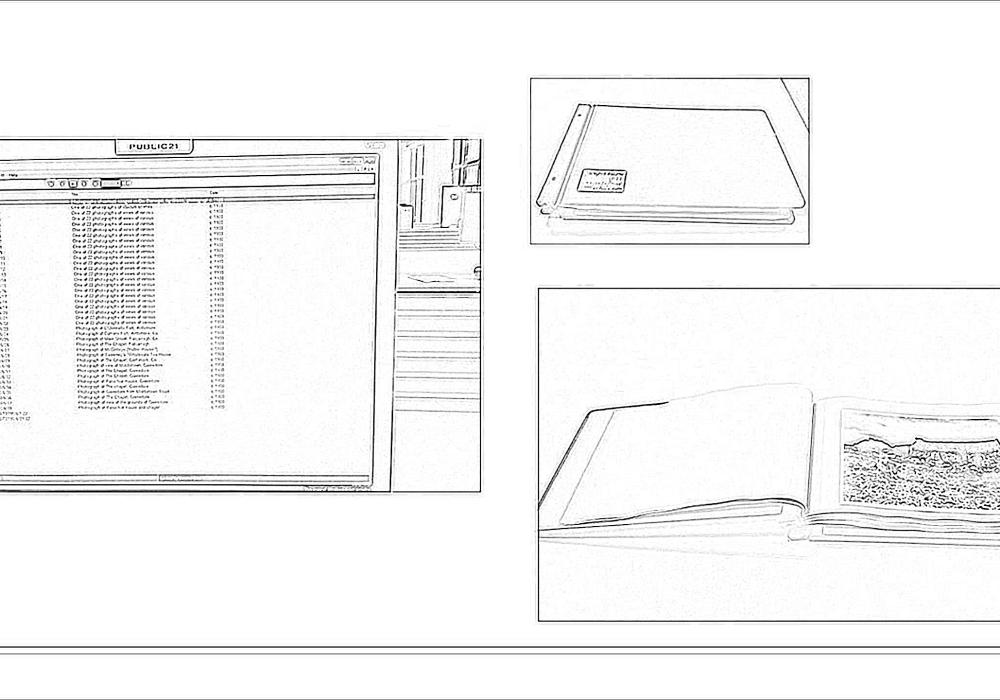
sketches of traces
what this research has been trying to do recently – and hence a recent hiatus in posting research online – is to identify, source and more directly engage with the relevant collected research materials, ie. the photo-albums of late nineteenth / early twentieth century ulster photographers james glass and william fee mckinney, these physical photo-objects, the internal and external digital databases and the archive sites in which they circulate – as the preliminary work to some kind of process of defining a typology or taxonomy – centred upon the relations of site, display, access and agency within the circulation of these archive albums.
that notion of negotiating the relations of site, display, access and agency within the circulation of objects perhaps works also as a definition of the act of curation itself.
some images from these preliminary research encounters with the physical photo-albums of late nineteenth / early twentieth century ulster photographers james glass and william fee mckinney, held in institutional and private collections, are reflected visually here only after their translation through simple online sketch software – as of course a practical issue re copyright and access, although as a device it also seems to envision the metaphor of a research process in which elements are yet to be defined:
combinations, manufactories
speculation on the relation and non-relation of elements within, between and across the photographs of william fee mckinney and james glass has the capacity to engage in genealogies of the radical, as variable traces made visible in the social, political and cultural frameworks displayed within their photographs and the social, political and cultural framework of the display of their photographs.
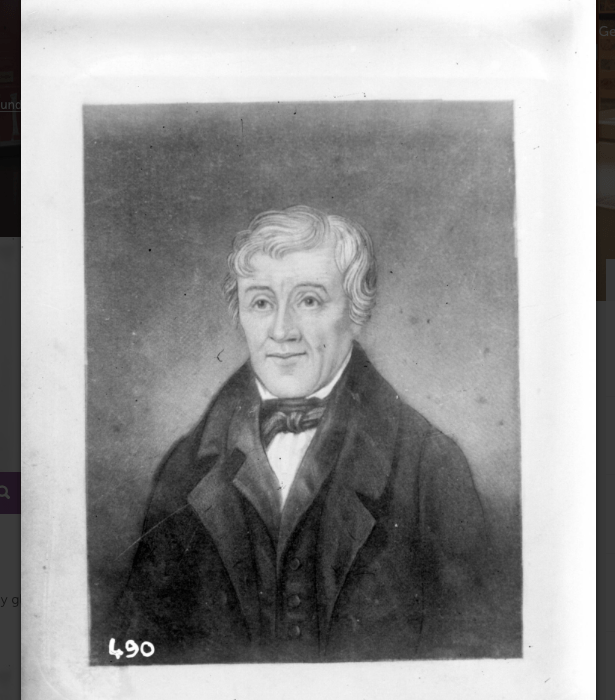
as an example, this photograph above the title by william fee mckinney (from the nmni collection – https://www.nmni.com/collections/history/photographs/dundee–mckinney-collection/hoyfmdundee490)
this is a photograph of a portrait of james hope (1764-1847), an antrim-born united irishman, from a series of engravings of prominent leaders of the united irishmen, produced for a book by madden on the subject published in the 1840’s. mckinney has photographed this portrait and stored within his albums, within a cultural framework wherein photograph albums served to contextualise the individual within genealogical, cultural, and familial histories (i), thereby contextualising mckinney, his kith and kin featured in the surrounding images, within some affiliation for james hope.
hope in facts stands somewhat apart from his fellow united irishmen and their legacies. he was of markedly lowly stock compared to many of his contemporary united irishmen, one of the few working men to attain a position of influence in the united irishmen … (and) … drawn to the united irish movement as a means of securing radical social change (ii), markedly aware of what we could call the class and socio-economic basis for radical and revolutionary action. some forty years after the united irishmen rebellion of 1798, james hope wrote:
there are circumstances which should be kept always before one connected with the events of 1798, to which their production is mainly attributed. as a people, we are excluded from any share in framing the laws by which we are governed. the higher ranks usurped the exclusive exercise of that privilege, as well as many other rights, by force, fraud, and fiction. by force the poor were subdued, and dispossessed of their interests in the soil; by fiction the titles of the spoilers were established; and by fraud on the productive industry of future generations the usurpation was continued… it was my settled opinion that the condition of the labouring class was the fundamental question at issue between the rulers and the people, and there could be no solid foundation for liberty, till measures were adopted that went to the root of the evil, and were specially directed to the restoration of the natural right of the people, the right of deriving a subsistence from the soil on which their labour was expended.
although james hope does stand as a class apart, and his socio-economic radical analysis sets him distinctly apart, from many in the united irishmen, and furthermore some of other local veteran united irishmen characterised as kith and kin by mckinney in his diaries had by the first decade of the 1800s become apparently ‘reformed characters’ voting for the act of union by 1801, this should not give the impression of any period of social, industrial and constitutional stability within mckinney family’s parish of carnmoney across his parent’s adult years, and his own early childhood years, the first decades of the 1800s. as outlined in the view from the ground of the mckinney family parish of carnmoney, from the ordnance survey memoirs of ireland, volume two, parishes of county antrim (i), 1838-9, ballymartin, ballyrobert, ballywalter, carnmoney, mallusk (i), in the account of carnmoney provided in the memoir by james boyle, 28th april 1839 we see in carnmoney a community in state of flux, featuring a period of serious industrial dispute in the area, following a rapid economic boom within a new industry and its new industrial technologies, and then a sudden impact on the economy of the community from new transport technologies, followed by ‘combination’ – nascent unionised activity amounts, when workers began to ‘combine’ or take a collective approach in an attempt to protect their interests. nb in the texts below the terms ‘printing’ and ‘printers’ refer to workers printing patterns etc onto textiles within the cotton trade:
manufactories and machinery: the manufactories and machinery of this parish consist of 5 establishments for spinning linen yarn, 1 establishment for printing cottons, 1 log wood mill, 1 threshing machine, 3 corn mills and 2 flax mills (47)
importance of cotton manufacture: in 1786 the first cotton manufactory in ireland was established in the adjoining parish of shankill and on the verge of this parish, by the late nicholas grimshaw esquire, who had previously come from england and settled in this parish. he soon after established the very extensive cotton printing and spinning manufactories which had until the year 1834 been carried on by his sons, and was the first to establish in this country a trade in which so much capital from this county has been embarked. the introduction of the cotton trade into carnmoney laid the foundation of the great improvement which it has since undergone. the extensive employment the manufactories afforded not merely occupies the few unemployed labouring people in this, but attracted numbers from the surrounding parishes to such a degree that the populous villages of whitehouse upper and whiteabbey are to them indebted for their origin and erection. the wages then given to printers and others were most liberal. the consumption of provisions and farm produce was of course materially increased, capital was more freely circulated in the parish and a stimulus was given to agriculture in consequence of the increased consumption of farm produce. (my emphasis) (51)
reasons for decline in cotton industry
the first check which was given to the prosperity of the cotton trade in this country was by the more general introduction of steam navigation, owing to which, principally, the trade has almost entirely left the country, and now there is not in reality a market for cotton in ireland. the cotton goods consumed in this country are purchased chiefly in manchester, which market has quite absorbed the irish ones. …
another and a main cause of the destruction of the printing business in carmoney, and that which eventually compelled its abandonment by the messrs grimshaw, was the system of combination which had existed among the workmen, but chiefly among the printers. combination had first appeared about 30 years ago, but it was not until the last 15 or 16 years that it assumed a systematic appearance or became by any means formidable. several strikes had taken place among the printers, and their obstinacy in refusing to come to terms was encouraged by the assistance which they received from ‘the trade’, and by the facility which they had for emigrating to england or scotland by the belfast steamer. latterly the system became so formidable and the annoyance and losses which they sustained by it became so serious that the messrs grimshaw in 1834 gave up the printing business, converted some of their cotton spinning machinery to that for the manufacture of linen yarn and let one of their mills to messrs bell and calvert. (52)
(i) Nicole Coffineau (2017) Alessandro Pavia’s Album dei Mille: Collection, Archive, and National Identity during the Risorgimento, History of Photography, 41:1, 61-75, DOI: 10.1080/03087298.2017.1292650
(i) https://www.historyireland.com/18th-19th-century-history/the-dog-that-didnt-bark-the-north-and-1803/
(ii) the ordnance survey memoirs of ireland, volume two, parishes of county antrim (i), 1838-9, ballymartin, ballyrobert, ballywalter, carnmoney, mallusk, pub the institute of irish studies, belfast & the royal irish academy, dublin, 1990
principles and elisions
we outlined in our previous postings the argument that we can identify within the photographic practices of both william fee mckinney and james glass the fierce sense of place, home, family that was situated within the irish popular mentality (i) of the late 19th/early 20th century. but we should not delimit our exploration within these two photographic practices to solely those discourses active only within the island of ireland and commonly related to nationalism / republicanism / sectarianism, or religious or contested national identity. within the body of these photographic practices, there will be displayed the traces of discourses that reach beyond these boundaries, that engage with ideas and events with transnational influence. historian nini rodgers has noted that
it was the revolutions in america and france that encouraged the political activities and ambitions of the ulster presbyterians … (with the revolution in France) … leading the world toward liberty, equality and fraternity, signifying the end to autocracy and the domination of aristocracy and priesthood. (ii)
for the period of this influence, the presbyterian community around sentry hill and carnmoney and the county of antrim was not in any way remote or distant from the influence of such ideas. it was in fact only some few miles from the centre of events and debate. as an example, the society of united irishmen, who sought to plant these reforming and revolutionary ideas in ireland, was formed by radical ulster presbyterians in nearby belfast in october 1791. the society sought the end of perceived injustices in social and legal conditions in ireland, among them the submission to a church of ireland aristocracy and any demand for tithes to such institutions – such as the tithe demanded by the local church of ireland aristocracy from the mckinney’s own farm.
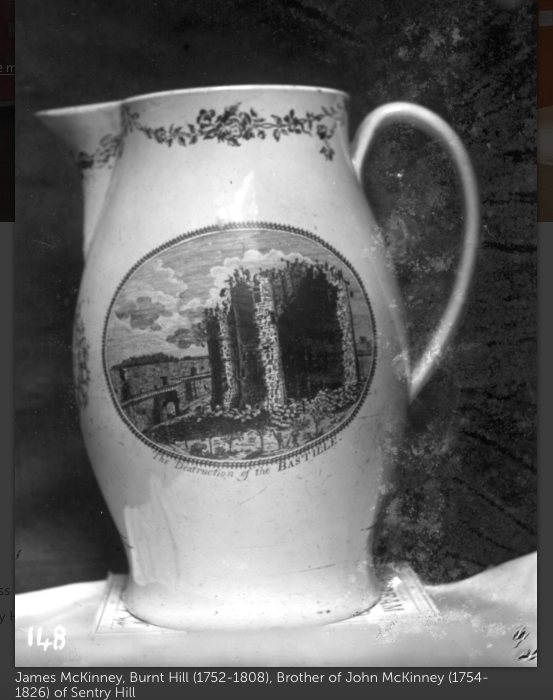
as evidence of the reach of such radical ideas within the mckinney family, there is an artefact featured within a photograph by william fee mckinney, and still physically present within the mckinney collection of family artefacts/heirlooms, which marks and celebrates late 18th century revolutionary events and radical political discourse across europe – the commemorative jug featured above, which celebrated the fall of the bastille in 1789, and which was presented to william’s grandfather’s brother james mckinney in county antrim in the 1790s.
and further, william mckinney’s own writings reflect upon how both his grandparents
joined the united irishmen who at first united only on reforms being made in the existing government without any intention of fighting…. (iii)
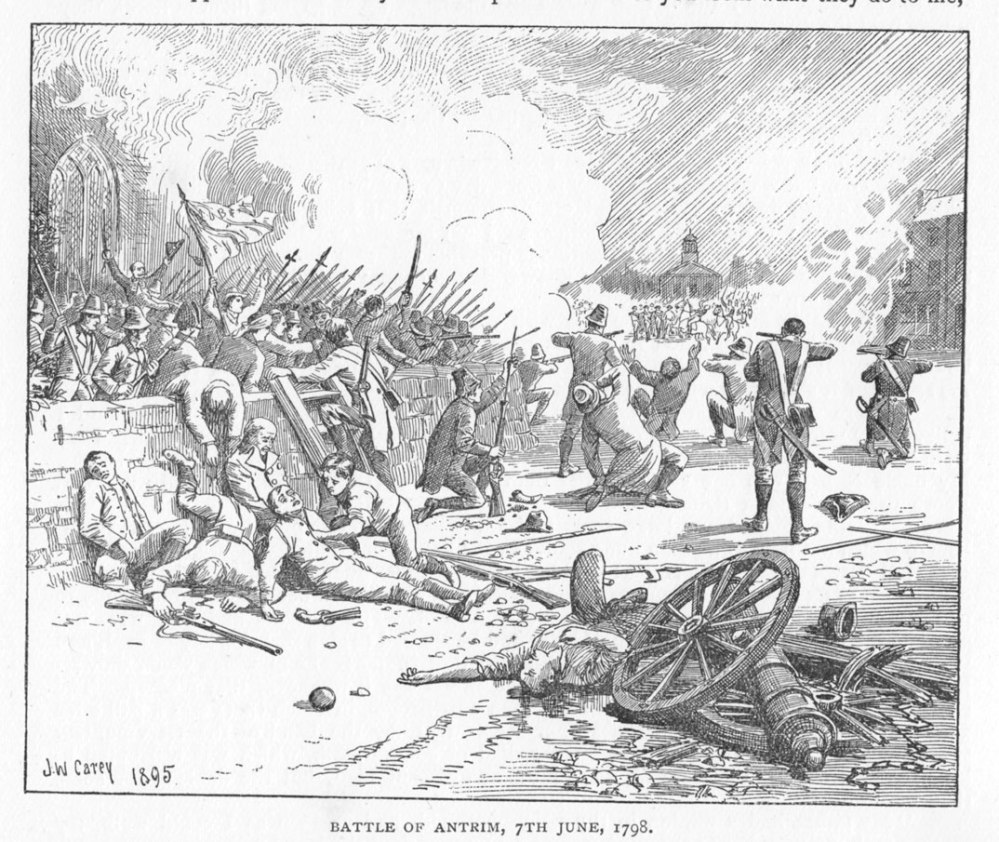
and after suppression and the execution of members of the society of united irishmen, preparations for their 1798 rebellion were commenced. and in the rebellion itself, in june 1798 mckinney’s grandfather carried the signal for local united irishmen to rise and march on antrim town – but the rebellion failed. william’s great-uncle, samuel george, was killed at the battle of antrim, an event that was still being commemorated visually within the period of mckinley’s own adult years by respectable figures such as the artist reverend jw carey of county down, who in 1899, set up a business in belfast (carey & thomson) specializing in high quality illuminated addresses, presentation albums, and book plates ( and we can speculate and research further any connection between carey’s business as a source for mckinney’s own albums).
there is a perspective which could propose that the primary reading of william fee mckinney’s adult years should recognise no role or influence of such radical ideas, as any engagement with radical causes within his familial or social milieu simply ceased after the 1798 rebellion. for example, it is recorded that in 1800 mckinley’s grandfather john mckinney, as a freehold voter, had signed a petition in favour of the act of union between england and ireland. (iv)
however, the defeat of the united irishmen
did not mean the end of their ideals, and dr william drennan, coiner of the principles of the united irishmen, was a founder in 1810 of the belfast academical institution, among whose aims was demonstrably the continuation of revolution by other, educational, means as articulated in drennan’s wish that: ‘ a new turn might be given to the national character and habits’ … (v)
and its is therefore noteworthy that subsequently, for three generations, the mckinneys selected this belfast academical institution as the primary educational influence upon most of the young sons within the mckinney family, with two of william fee mckinney’s brothers and all of his own sons and several of his grandsons being taught there. of course across a century from the late 1790s onwards, the urgency and visual primacy of such radicalism did diminish but it could be argued – despite the fact that in 1831 the school the belfast academical institution accepted the title of ‘royal’ preferred by king william iv (as the institute itself argues, this was a process engaged in less out of loyalty, than the need to appropriately distance the institution, in the later nineteenth century, from its radical-republican origins and to secure a government grant to maintain the collegiate department (vi) ) – that the role of the royal belfast academical institution within the family lineage of the mckinneys, through the shared relation within the lineage of the school and the mckinneys to 1798, the united irishmen and allied radical, reformist and revolutionary ideas, functions at least as trace of this radical lineage.
so can the strands of the radical, reformist and revolutionary perhaps be traced within the photographic practice of william fee mckinney himself? we can speculate for now that the photographs by william fee mckinney below, of his grandchildren thomas mckinney and jack dundee, may feature a belfast academical school uniform or at least a belfast academical school cap :
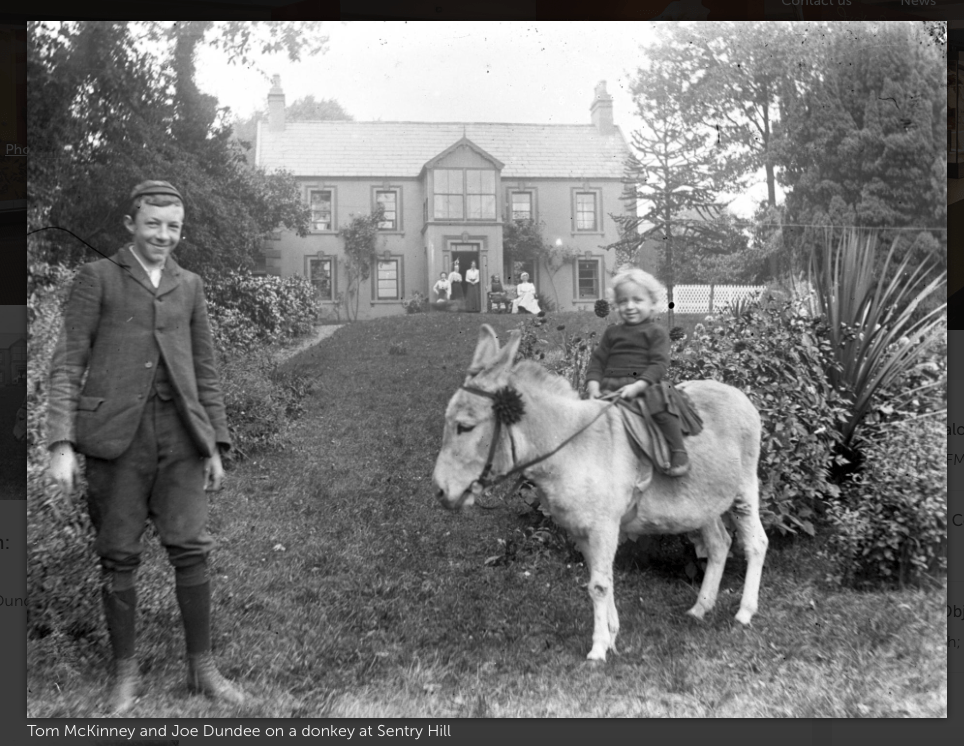
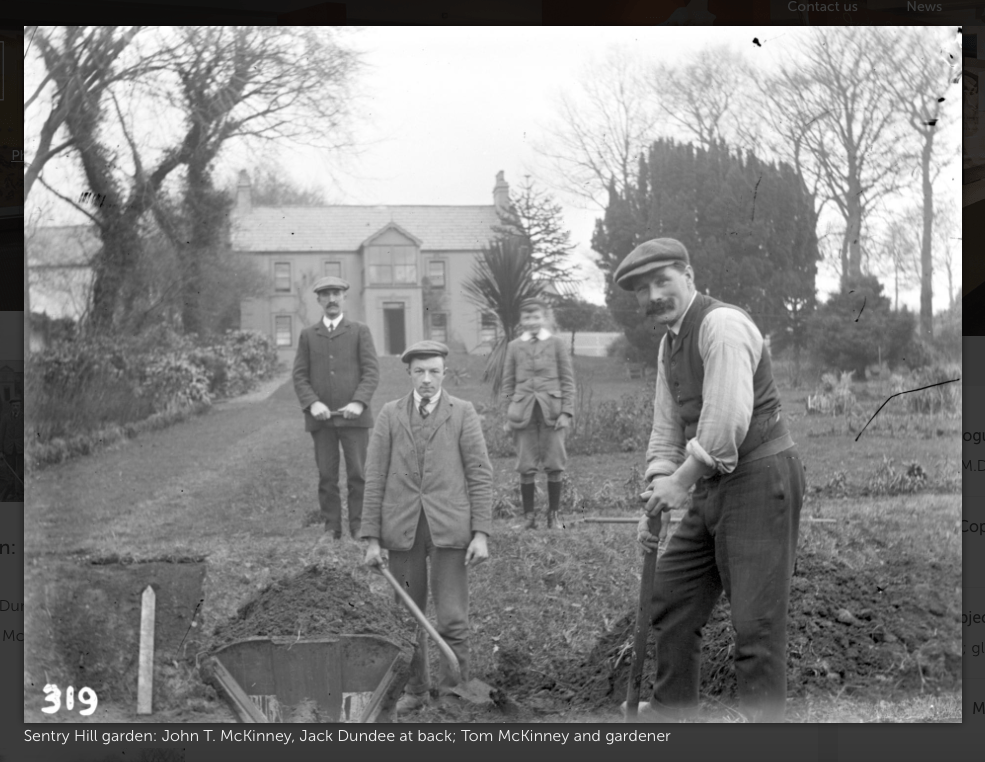
from such traces being identified and made visible in the photographic practice of william fee mckinney, we have been able to indicate the progressive elision of the radical, reformist and revolutionary from the presbyterian community within which the mckinneys of sentry hill worked and lived. as the united irishmen had the radical aim of uniting ‘protestant, catholic and dissenter’ we can perhaps characterise this as the regressive elision of dissent from the dissenter. but we can, through a process of indicating signs of this lineage where they are displayed within the photographic practice of william fee mckinley, develop an argument against this visual elision.
furthermore, we can can expand this argument beyond the specificities of the framework solely of ulster and ireland.
for the mckinney’s, the period of their relationship to sentry hill across the 1790s to the 1880s commenced with john mckinney (william mckinney’s grandfather) acquiring a 31 year lease on a 20 acre property – and with both of william fee mckinney’s grandfathers being engaged with the radicalism, rebellion and reform, the french revolutionary ideals of liberty, legality, fraternity, and the united irishmen. and the period ended with william fee mckinney having by the 1880’s full (non-leasehold) ownership of almost 100 acres, and with him acting as a minor landlord of farming land and of built property, so accumulating financial capital allied to an accumulation of social and cultural capital, such as a developing influence for william within the respectable bodies and institutions of his local community around sentry hill and developing affiliations with respected belfast societies etc.
so we can outline a gradual process across this period within which any agency as radical or dissenter was being eclipsed by agency as a secure part of the bourgeoisie.
the historian marc mulholland’s bourgeois liberty and the politics of fear can be used to indicate a key perspectives on reading such a process, by letting us survey the developing ‘radical to bourgeois’ status of the mckinneys at sentry hill through the broader perspective of european history and class history. initially quoting jurgen kocka, outlining that within the development of the bourgeoisie across this late 18th to late 19th century period, the parallels with the development of the mckinneys at sentry hill are striking:
in the eighteenth and nineteenth centuries, they (the bourgeoisie) set themselves apart from the world of aristocratic privilege, unrestricted absolutism, and religious orthodoxy;
– within this argument we could situate the mckinney’s allegiance to radicalism, rebellion and reform, the french revolutionary ideals of liberty, legality, fraternity, and the united irishmen and participation in rebellion –
and in the nineteenth and twentieth centuries… ( they (the bourgeoisie) set themselves apart) … from those below them, the lower strata, the people, the working class… the different sections of the bourgeoisie shared a common culture, defined by a specific type of family life and unequal gender relations, respect for work and education, and emphasis on personal autonomy, achievement and success; and by a specific view of the world and a typical style of life in which clubs, associations, and urban communication played an important role. (vii)
mulholland’s analysis continues to almost mirror this latter social framework of the mckinneys of sentry hill as displayed within the photographic practice of william mckinney:
the point about bourgeois civil society, with its foundation of association, family, education, and assets of inherited property and wealth, is that it prepares its members to actualise their marker potential not just through formal education, but also childhood socialisation into habits of self-confidence, communication skills, and attunement with the dominant culture of success. bourgeois ‘habitus’, as pierre bourdieu put it, generates valuable ‘social capital’ and ‘cultural capital’, which in turn leverages ‘real’ capital… (viii)
(i) kevin whelan, eviction, in ed. wj mccormack , the blackwell companion to modern irish literature, oxford, 1999 quoted in l. perry curtis, the depiction of eviction in ireland 1845-1910, dublin, ucd press, 2011, p24
(ii) nini rodgers, “transatlantic family journeys”, in faith and slavery in the presbyterian diaspora, ed. william harrison taylor, peter c. messer, rowman & little field, 1988
(iii) william fee mckinney quoted in brian walker, sentry hill: an ulster farm and family, dundonald, blackstaff, 2001
(iv) http://www.bbc.co.uk/ahistoryoftheworld/objects/sBUMrosHRsqp6HkinzkVCA
(v) david cairns & shaun richards, writing ireland: colonialism, nationalism, and culture, manchester, manchester university press, 1988, p22
(vi) http://www.rbai.org.uk/index.phpoption=com_content&view=article&id=3&Itemid=362
(vii) marc mulholland, bourgeois liberty and the politics of fear: from absolutism to neoconservatism, oxford, oxford university press, 2012, p4
(viii) marc mulholland, bourgeois liberty and the politics of fear: from absolutism to neoconservatism, oxford, oxford university press, 2012, p7

trinities, refractions
part of the initial impetus to this research across two contemporaneous late 19th/early 20th century ulster photographic practices (james glass and william fee mckinney) was the potential to research themes and tropes reflected or refracted between them. as examples: a studio photographer and an amateur photographer, the north-west and the east of ulster, the contested national identity within derry and the solid national identity within county antrim, the ‘genres’ (to borrow the terminology of critic karen strassler, see below) present across their photographic practices of studio portraiture, social document, family album.
that notion of refraction is engaged with by karen strassler in her research into photography, identity and national identity in java across colonial and post-colonial periods. speaking of the bodily pose within the framework of studio portraiture as a ‘genre’ she writes
this bodily molding anticipates being seen by others and is a bid to be recognized in a particular way. as subjects of photographs, people both appropriate available image-repertoires to stake claims to particular identities and social positions and, at the same time, are subjected to ideologies and narratives attached to these visual appearances that are not entirely of their own making. the term “ refraction” also illuminates the processes of redirection and transformation that occur as ways of seeing, modes of interpretation, and habits of practice attached to one photographic genre or representational form refract within another.(i)
and to use even only the images that we have already encountered within this blog, we can still ask could such refraction be functioning here:

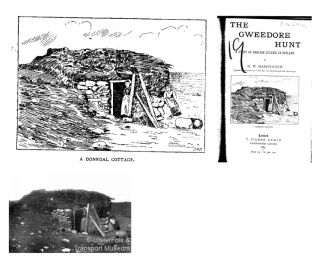
(l. william fee mckinney photograph / r. james glass photograph and copy in campaigning land war pamphlet / see blog entries below for more details)
there is in the most simplistic sense some presence of habitat/property and inhabitant shared across all these images. in fact it is it is crucial to acknowledge how opaque or transparent such an instinctive reading is, and what such opacity or transparency may itself indicate. what is striking for now is that each of these images resonates not just with habitat/property and inhabitant as a platonic ideal, but rather within what could be called a range of refraction for the thematic of place/home/family that functioned as a central trope across late nineteenth-century ireland:
haunted by the ubiquity of displacement and family disintegration, the irish popular mentality nurtured as a counterpoise a fierce sense of place, home, family. any forces which threatened this trinity destabilised the equanimity of the popular imagination. (ii)
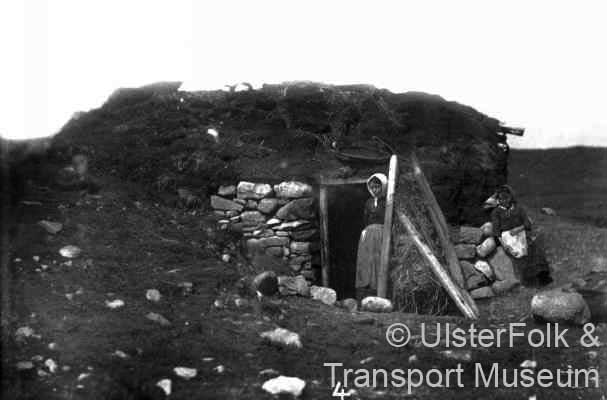
while the james glass photograph of ‘view of ruinous gweedore dwelling with occupant’ may be the kind of visual sign that we would expect to see constructed from within that central trinity of place/home/family in the popular mentality in late nineteenth-century ulster, it is vital to acknowledge the status of this photograph as the visual survey of an outsider, and to question the relationship and the refraction between the language of display and the function of making a photographic social document (which was not the primary photographic genre exercised by james glass), and the language and function of making a photographic portrait (which was the primary photographic genre exercised by james glass).
and while the line-drawing copy in massingham’s campaigning pamphlet of james glass’ ‘view of ruinous gweedore dwelling with occupant’ may be the kind of visual sign that we would expect to see constructed from within that central trinity of place/home/family in the popular mentality in late nineteenth-century ulster, it is vital to acknowledge its lineage as the visual survey of a series of outsiders, first the photographer as outsider, then author as outsider and then copying artist as outsider , and to examine within the image the refraction of meanings, intent and agency for the photographer, for the photographic subject and for the author/campaigner and the copying artist.
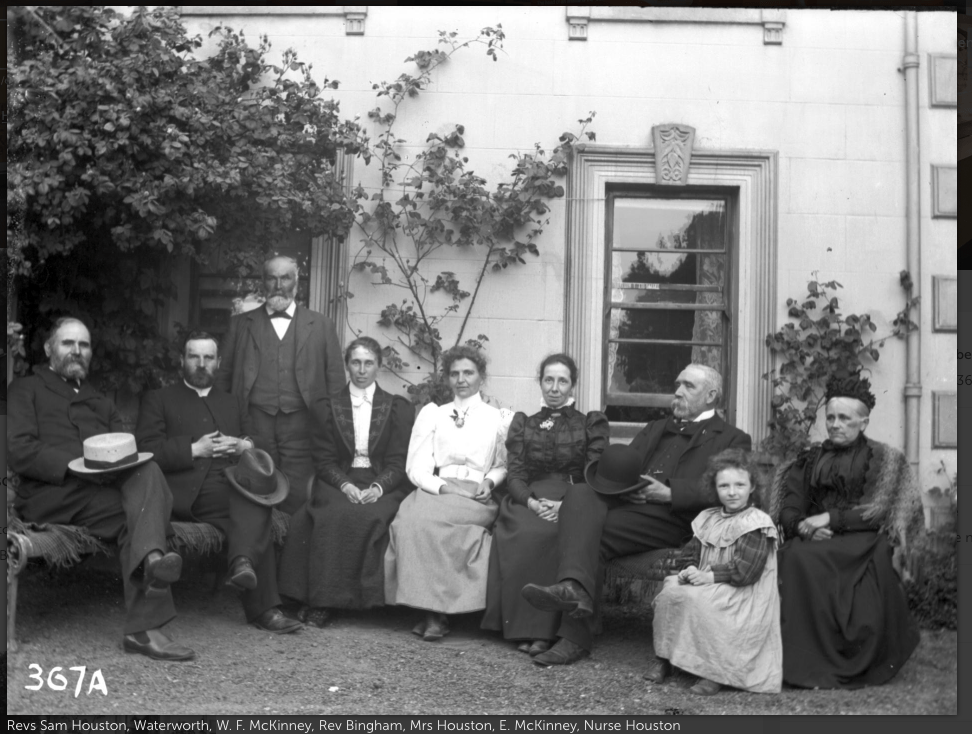
the william fee mckinney photograph of a social gathering at sentry hill in county antrim may not be the kind of visual sign that we would expect to relate to the discussion of eviction and the attendant central trinity of place/home/family in the popular mentality in late nineteenth-century ulster. however, in this photograph, can that destabilising central threat of eviction, that central trinity of place/home/family in the popular mentality in late nineteenth ulster be seen refracted across ulster west to east? mckinney’s photograph is, as already indicated below, part of the informal socialization of elite groups but it also functions to identify the central trinity of place/home/family for an ulster presbyterian community in the era of the land war, to display their own secured connection to their place for an ulster presbyterian community in the era of the home rule crisis.
(i) karen strassler, refracted visions: popular photography and national modernity in java, duke university press, 2010, p26
(ii) kevin whelan, eviction, in ed. wj mccormack , the blackwell companion to modern irish literature, oxford, 1999 quoted in l. perry curtis, the depiction of eviction in ireland 1845-1910, dublin, ucd press, 2011, p24

‘seen and witnessed’
contemporary and historical perspectives which reinforce a sense that across the latter half of the nineteenth century the western counties of ireland and westernmost county of ulster served as sites for repeated instances of observation and survey – what could be described as open laboratories for processes of interpellation – are broadly discussed across a range of literatures: for example from twentieth century academic biography referenced via twenty-first century local history:
the subject of deprivation in ireland preoccupied the british authorities for the greater part of the nineteenth century; it was the main issue addressed in all government reports between 1887 and 1890. (i);
to a contemporary account from within late 1800’s ulster such as schoolteacher hugh dorian’s ‘history from below’, outlining within the specific language of vision and visibility the contemporary popular consciousness of the population being a locus of observation and survey:
at the present time, 1889, all eyes of feeling christians of the united kingdom and of many parts elsewhere are directed towards donegal (ii).
furthermore, as dorian continues within his own footnotes to outline briefly the specific land war events of that year of 1889 which had led to this particular experience of observation, he uses again within his account the language of vision and specifically the language of visibility as witness, indicating that within this social framework judicial actions specifically functioned as instances of display, and that such actions were experienced through visual metaphor and visual analogy, and all at a geographical reach across a large province such as ulster:
priest and peasant, the old man, the sturdy youth and the blooming maid, taken prisoners, marched between two file of soldiers from gweedore to derry gaol. anyone who had seen witnessed the procession from pennyburn to bishop street queen’s hotel, can never forget it …it could not be compared to roman victory or procession in days of paganism. it was more like hell opened until the iron gates closed upon their prey … (iii)
and so a set of land war events in the western edges of ulster are not only reported within contemporary print media, but also refracted as spectacle on the streets of ulster’s second city derry.
and the specific set of land war events in the western edges of ulster reaches further still, refracted again within the spectacle of a ‘massive indignation meeting’, in fact ‘one of the finest meetings ever held in the city’ within the ulster hall in belfast in february 1889, discussing these specific distant land war events in the western edges of ulster as part of the broad contemporary debate about the issue of land and home rule, and discussing the events once again within the language of display and appearance, with a reverend kane projecting in his speech from the podium for his assembled audience a fixed image, declaring that the people of the gweedore region were ‘ as innocent and credulous as the painted children of the prairie’ (iv).
and in terms of photographic practice within ulster in this period, contemporary photographs of living conditions within the region of gweedore by the derry photographer james glass also now gain further traction with one photograph copied as a graphic to feature on the cover of a liberal reformist’s pamphlet on the issue of land and home rule and the events within the gweedore:


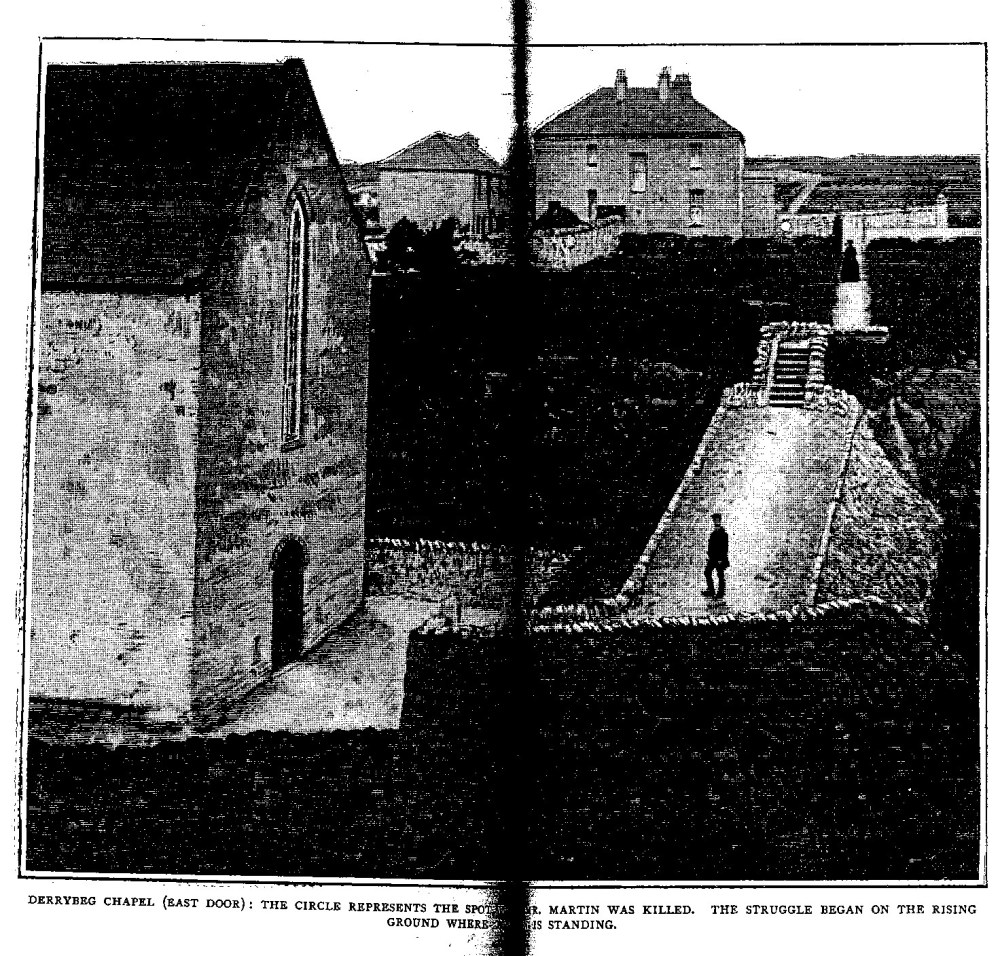
and another of james glass’ photographs of the setting of these specific land war events presented and annotated as visual evidence – a theme to which we shall return – included within the pamphlet itself (v):

(i) Arthur Balfour’s Tour of Donegal (1890) by S. Beattie in ed. S. Beattie, Donegal Annual: Journal of the County Donegal Historical Society No.57, Donegal, 2005 referencing Catherine B. Shannon. Arthur J. Balfour and Ireland, 1874–1922. Washington, D.C.: Catholic University of America Press. 1988
(ii) and (iii) ed. Breandán Mac Suibhne and David Dickson, The Outer Edge of Ulster: A Memoir of Social Life in Nineteenth-Century Donegal by Hugh Dorian. Notre Dame, University of Notre Dame Press, 2001
(iv) from the belfast newsletter, 15 feb 1889, discussed in Breandán Mac Suibhne and David Dickson.
(v) images from the NMNI collection specified as the James Glass Album, and the publication H. W. Massingham, The Gweedore Hunt: A Story of English Justice in Ireland, London, 1889.

